Most bettors start with direct bookmaker accounts. Bet365, Paddy Power, BoyleSports, familiar names, easy to open, nothing to explain. Then, sooner or later, something goes wrong: the account gets limited, the best odds turn out to be sitting somewhere else entirely, or the bookmaker they actually want to use simply doesn't accept registrations from their country. That's usually the moment the broker question starts to feel relevant rather than theoretical.
This isn't a single, clean comparison, and I'd push back on anyone who tries to sell it as one. It depends entirely on which direct bookmakers you're comparing against, what your betting volume actually looks like, and whether you're dealing with a genuine access problem or a restriction problem (they're not the same thing, even though people talk about them as if they are). This page lays out the variables clearly so you can make the right call for your own situation.
Direct Bookmaker Account vs Betting Broker: What Each Route Means
Direct Bookmaker Account
You register directly with a bookmaker under your own name. You fund the account in your own name. The bookmaker's risk system tracks your betting patterns, profitability, and market selection. Profitable bettors are typically limited or closed. The bookmaker's margin is built into every price: you never see it as an explicit cost, but it is always there.
Betting Broker Account
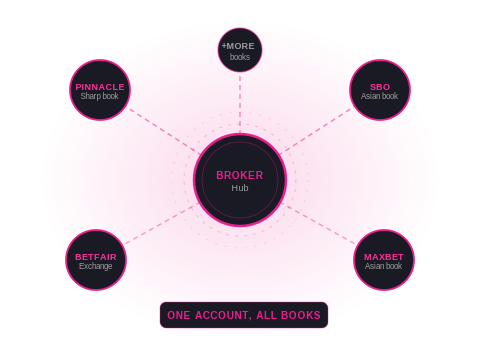
You register with a licensed intermediary that holds institutional accounts with multiple bookmakers. You fund one broker account. Bets are placed through the broker, which routes orders to the underlying bookmaker. The bookmaker sees an institutional client, not an individual. You pay explicit commission (~1% of stakes). No individual profiling occurs. Country restrictions are resolved by the broker's institutional access.
Broker vs Direct Bookmaker: Criteria Comparison
| Criterion |
Direct Bookmaker (Soft European) |
Direct Bookmaker (Sharp, e.g. Pinnacle) |
Betting Broker |
| Account restrictions |
Likely for winners |
No: sharp books don't limit |
None: institutional model |
| Gubbing |
Very common |
Does not apply |
Does not apply |
| Book margin |
6–12% |
1–2% |
Underlying book margin (1–3% for Asian books) |
| Explicit commission |
None |
None |
~1% of stakes |
| Total effective cost |
6–12% margin |
1–2% margin |
1–3% margin + 1% commission |
| Ireland: Pinnacle access |
N/A |
No (restricted) |
Yes ✓ |
| Market depth |
Wide but low limits for winners |
Deep, no limits |
Deep: same as underlying books |
| Asian Handicap access |
Limited / low quality |
Full: best in market |
Full: Pinnacle, SBO, ISN |
| Multi-book access |
One book per account |
One book per account |
Multiple books via one account |
| Long-term account stability |
Low: degradation over time |
High |
High |
When Direct Bookmaker Access Is the Better Choice
Direct access to a sharp bookmaker, Pinnacle above all, is the theoretically optimal setup. Low margin, no commission layer sitting on top of it. The effective cost of Pinnacle direct works out at 1 to 2% in book margin, versus 2 to 3% for Pinnacle via broker once commission is added. Simple enough on paper.
Direct Pinnacle access is only available to bettors in non-restricted countries. Ireland is on Pinnacle's restricted list. Most other Western European countries are also blocked from direct Pinnacle registration. If you are in a restricted country, this option simply does not exist: the broker route is the only available path.
Direct European bookmaker accounts (Bet365, Paddy Power, BoyleSports) are accessible but operate on the soft book model. They are useful for recreational betting, matched betting, and exploiting sign-up offers. For serious, high-volume value betting, the margin differential and the restriction risk make them unsuitable as a primary long-term operation.
When a Betting Broker Is the Right Choice
Three situations make the broker route the clear correct choice:
Country Restrictions
You are based in Ireland or another country where Pinnacle, SBO, and the Asian suite are inaccessible directly. A broker account with AsianConnect or BetInAsia resolves this immediately: both accept Irish registrations and provide full Pinnacle access.
Account Restrictions
Your direct soft bookmaker accounts have been gubbed or limited. The broker route bypasses the individual profiling model entirely. The bookmaker never sees your personal account, only the broker's institutional account. For bettors who have exhausted their direct soft book accounts, brokers are the primary operational infrastructure.
Access to Sharp Markets
You want to bet at the sharpest books in the market (Pinnacle, SBO, ISN), which have the lowest margins and the deepest limits. Whether or not you face restrictions, the odds quality at these books is the primary reason professional bettors use them. A broker is the access mechanism.
What Professional Bettors Actually Do
Most professional bettors in Ireland and Europe don't actually choose between direct and broker. They run both in parallel, each allocated to a different purpose, which is honestly the more sensible approach once you've been around long enough to see how the accounts age:
Soft book direct accounts are maintained while they remain healthy, used for promotional offers, matched betting, and markets where the soft book has the best price. These accounts are treated as temporary assets that will eventually degrade.
A broker account (typically AsianConnect as the primary) is the permanent operational core. It provides access to Pinnacle and the Asian suite without restriction. It functions regardless of whether the bettor's soft book accounts are active or have been closed.
Betting exchanges (Betfair, Orbit Exchange) are typically accessed directly, since exchange accounts do not restrict winning bettors. Exchange activity complements the broker account for in-play trading, lay betting, and markets with better exchange liquidity than bookmaker liquidity.
This three-layer setup (soft books while available, broker for sharp access, exchanges direct) is the architecture most serious bettors converge on after spending time in the market. For a full overview of how brokers fit into this picture, see how betting brokers work.
Frequently Asked Questions: Broker vs Direct Bookmaker
Is a betting broker better than using a bookmaker directly?
It depends entirely on which bookmakers you are comparing. A betting broker is specifically better than a soft European bookmaker for professional bettors: it provides access to sharper books, eliminates account profiling and restrictions, and delivers better long-term odds quality. However, a broker is not inherently better than every direct bookmaker option. Direct access to Pinnacle (for those outside restricted countries) and direct exchange accounts (Betfair, Orbit) are excellent for the bettors who can access them.
Can I get limited or gubbed through a betting broker?
No. This is one of the defining advantages of the broker model. The broker holds institutional accounts with the underlying bookmakers. The bookmaker deals with the broker as an institutional client, not with you individually. Your betting pattern is invisible to the bookmaker's risk profiling system. This is why professional bettors who have been gubbed by every major soft book can continue operating at full stakes through a broker.
Do brokers provide better odds than direct bookmakers?
Brokers provide access to better books, not necessarily better prices. The underlying odds at Pinnacle or SBO are sharp: 1–2% margin versus 6–10% at soft books. After adding ~1% broker commission, Pinnacle via broker typically still delivers better long-term expected value than a soft European book at zero commission. The comparison should always be against the actual books the broker provides access to.
Why do professional bettors use brokers instead of opening bookmaker accounts directly?
Three main reasons: (1) country restrictions prevent direct access to the sharp Asian books, as Pinnacle, SBO, and ISN don't accept direct Irish registrations; (2) soft bookmakers impose stake limits and account restrictions on consistent winners, while the broker model bypasses individual profiling; (3) consolidation: one funded account for access to multiple sharp books is operationally simpler than managing five separate direct accounts at the sharp end of the market.
Is a broker more expensive than using a bookmaker directly?
The broker charges explicit commission (~1% of stakes) that a direct bookmaker account does not. But the relevant comparison is the total cost including the bookmaker's built-in margin. Pinnacle via broker (1% margin + 1% commission = ~2% total cost) is substantially cheaper than Bet365 direct (6–10% margin, no commission). The comparison changes if you already have access to Pinnacle directly: in that case, a broker adds commission without reducing the underlying margin.
When is direct bookmaker access the better choice?
Direct access is better when (a) you can access the sharp books directly, i.e. you are outside the restricted countries for Pinnacle and SBO, and (b) you have not been limited or gubbed. For bettors who can open and maintain healthy direct Pinnacle accounts, going direct avoids the broker commission layer. For Irish bettors, this option doesn't exist: Pinnacle restricts direct Irish registrations.